Provence and Occitanie: Day 7
Updated: Jan 18
Arles: Roman Remains, Van Gogh Visions, Crypts and Cloisters

We chose Avignon as our “home base” for about a week not because it's centrally located (it's not, really) to where we would be traveling, rather because of the ease of which we could rent the car, park, drive in and out, and still be near the hotel. Our grand itinerary formed something of a Provence Triangle: Marseille to the southeast, Avignon to the north, and Montpellier to the southwest. Thus, I also reasoned, Avignon as the top point of our vacation isosceles would be an ideal launching point for visiting the other sites in our week of day-trips. It worked out well.

Our first jaunt via BMW was Arles, a city at the northernmost point of the large area in Southern France known as the Camargue. The Camargue is a lowland estuary where the Rhone empties into the Mediterranean. It's full of salt marshes and thus commercial salt works, white horses (no longer roaming free), and pink flamingos. It's central to Roma culture, but I'm not going to get into all this until a later post discussing our trip deep into the Camargue. For on this day, we settled for Arles.
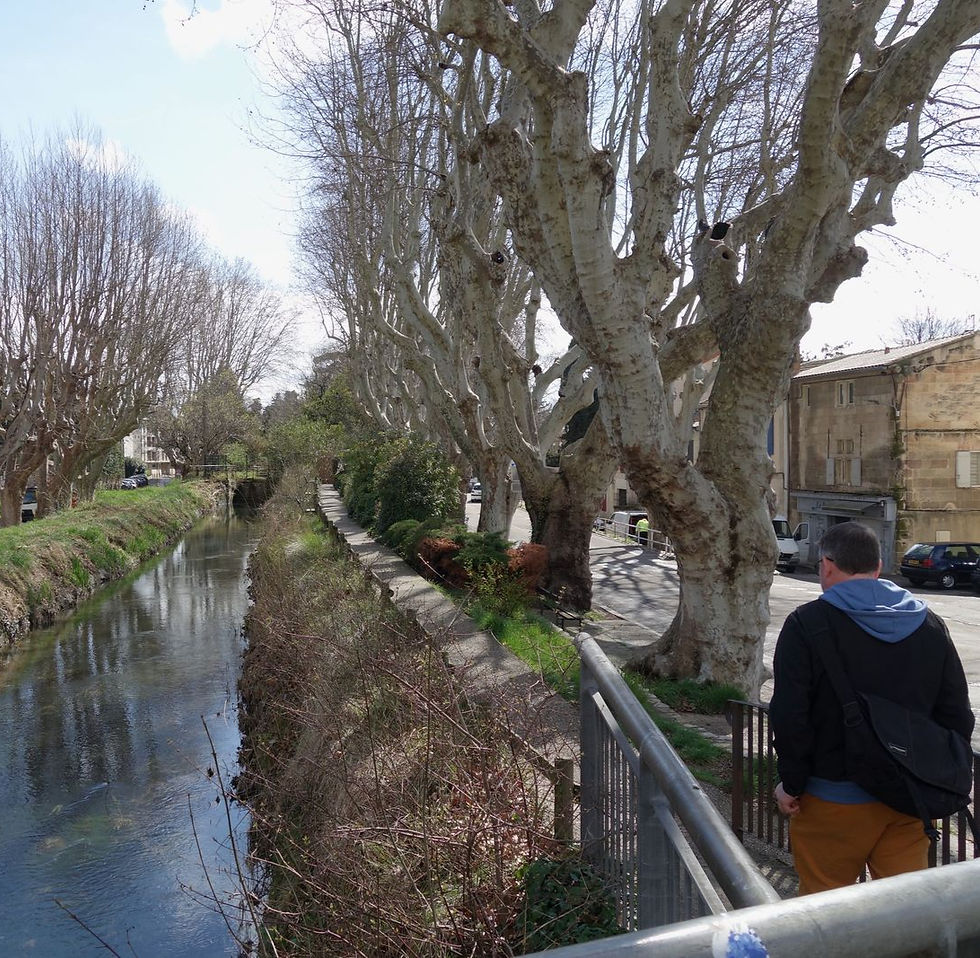
I should not say “settled” as Arles is a top tier destination and not a place one merely settles for. Speaking of settling, Arles (or in ancient times, Arelate) was originally settled by various Gaul peoples, then Phoenicians, then, about 123 BCE, the Romans finally moved in. Emperor Constantine loved the area and spent a lot of time there. His son, the shockingly named Constantine II, was born there. The Roman influence and remains are one of the more spectacular aspects of what makes current-day Arles a must-see.
As if a batch of spectacular Roman ruins aren't enough to tempt you to Arles, the fine city was also the home of Vincent Van Gogh in the late 1880s. In fact, most of what we remember as Van Gogh’s masterpieces were created during his short and tumultuous stay in Southern France. Vincent Van Gogh tributes and historical markers dot the city and are another reason Arles is incredibly memorable and a true gem.

Arles is actually a sack of gems. A big treasure chest of gorgeous jewels. There is so much to see in Arles, so many sites to wander in, around, and through, allowing one to contemplate history, art, and some really cool words (like necropolis). The sheer number of places we visited in Arles actually makes my head spin to this day. I don’t want to give any of the places short shrift, but I also don’t want to leave any of the places in the dustbin of my travel blog, so allons! Vite, vite, dépêchons-nous!


After we surprisingly found a great parking spot along Rue Emile Fassin, we walked about 300 meters to the aforementioned necropolis, Alyscamp. This is an ancient Roman graveyard that looks like something out of one of my video games, where skeletal warriors slide the heavy stone slabs on their sarcophagi and spring out ready to do battle. It’s basically a street lined with tombs, trees, and chapels. Stroll for a while and explore the open temple buildings. Imagine not only the Roman and medieval times (Dante Alighieri mentioned Alyscamp in Divine Comedy) but also think about Van Gogh and Paul Gauguin spending time here painting in 1888. Under the blue early spring sky, the outdoor walk around tree and tomb-lined Alyscamp was the ideal way to begin our long, meandering walk around Arles.

From the tombs to the place that may have been responsible for filling some of the tombs in Arles: the Roman arena! I am not sure how many Roman arenas remain extant in the world, but the fact that there are two in Southern France (the other is in Nimes, which we saw as well) is just so wonderful. The Arles arena is excellently preserved, accessible, and has a view of Provence and Camargue that you will remember until the end of your days puts you in a necropolis of your choice. It is still in use for contemporary events, so there is a lot of modern scaffolding and bench seating, but don’t let that break your historic imaginative immersion. It’s a wonderful monument, stunning, and worth the trip to Arles if that were the only site.
Due to the sheer number of sites to visit in Arles, many of which are ticketed and have a modest entry fee, we opted for the Advantage Pass which, for about $20, gives access to six monuments and some museums. We took advantage of the Advantage Pass in that we visited most of the monuments. With ease of entry, the handy phone app will get you into the major ticketed sites and save you some green. Or blue. Or whatever color euros happen to be.
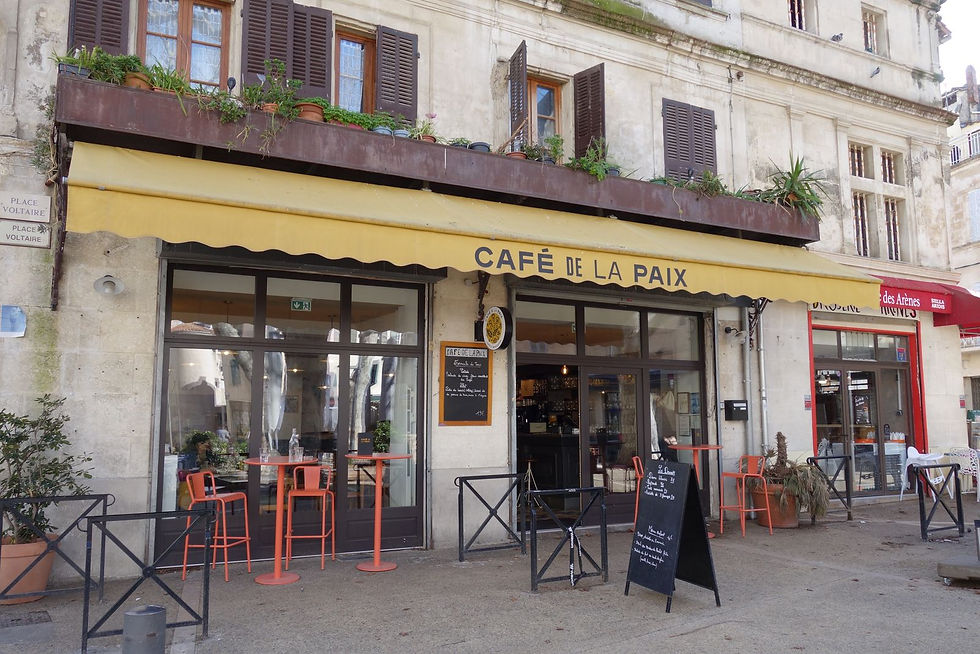
After the arena, we stopped at Café de la Paix in La Place Voltaire for a quick refresher of salad and carafe of gris wine. I am not a big day-drinker, but a 500ml carafe of not-quite rose and not-quite red (thus, gris) hit the spot and put a spring in our weary urban walk vacation steps. While we relaxed at the brasserie, we became aware of some local criminal element going about their daily deeds. It was nothing violent or dangerous, and they didn't bother us, nor us them, but they were most definitely engaging in actions that ran afoul of local laws. It was quite entertaining and a great pageant for us to enjoy while drinking and dining.

After our short repast, we walked just a bit to the north along Rue Voltaire to the really striking Fountain Amedee Pichot with its gorgeous colorful medallion, lion bas relief, and columns. It stands just before, or after (depending upon whether you are coming or going), Port de la Cavalerie (Cavalry Gate), a narrow passage between two stone towers attached to the remains of a wall that serves as a reminder of the era in which Arles was a much smaller, walled city. Believe it or not, these were not the destinations we sought when we trekked to the north from the plaza. For what we sought was no longer there. Our destination was empty and we knew it. A chimera, you ask? A figment of tired tourist imagination? Were we delusional to walk outside stone walls in search of nothing, no remains, rien?
We were, in fact, quite lucid and aware of our surroundings and the place we were drawn to. In 1888, Vincent Van Gogh and Paul Gauguin shared a house at 2 Place Lamartine, a boulevard just outside the Port de la Cavalerie. Van Gogh created a painting of the house, and the picture has become a quite famous classic. Unfortunately, the Allies during World War II bombed Arles, and in an attempt to hit the train station from the sky, they blew up Van Gogh’s old digs. I blame the Nazis. They started the damn war, murdered millions of innocent people, occupied huge swaths of Europe (including Arles), and destroyed everything they touched. The Allies may have done the immediate deed, but the fascists are responsible. Remember, fascists ruin everything. While The Yellow House, in the grand scheme of things, is minuscule in terms of tragedy from WWII, it still pisses me off (and it should piss you off as well). There is an easel showing Van Gogh’s painting and an empty lot with green grass and trees, so that’s nice.

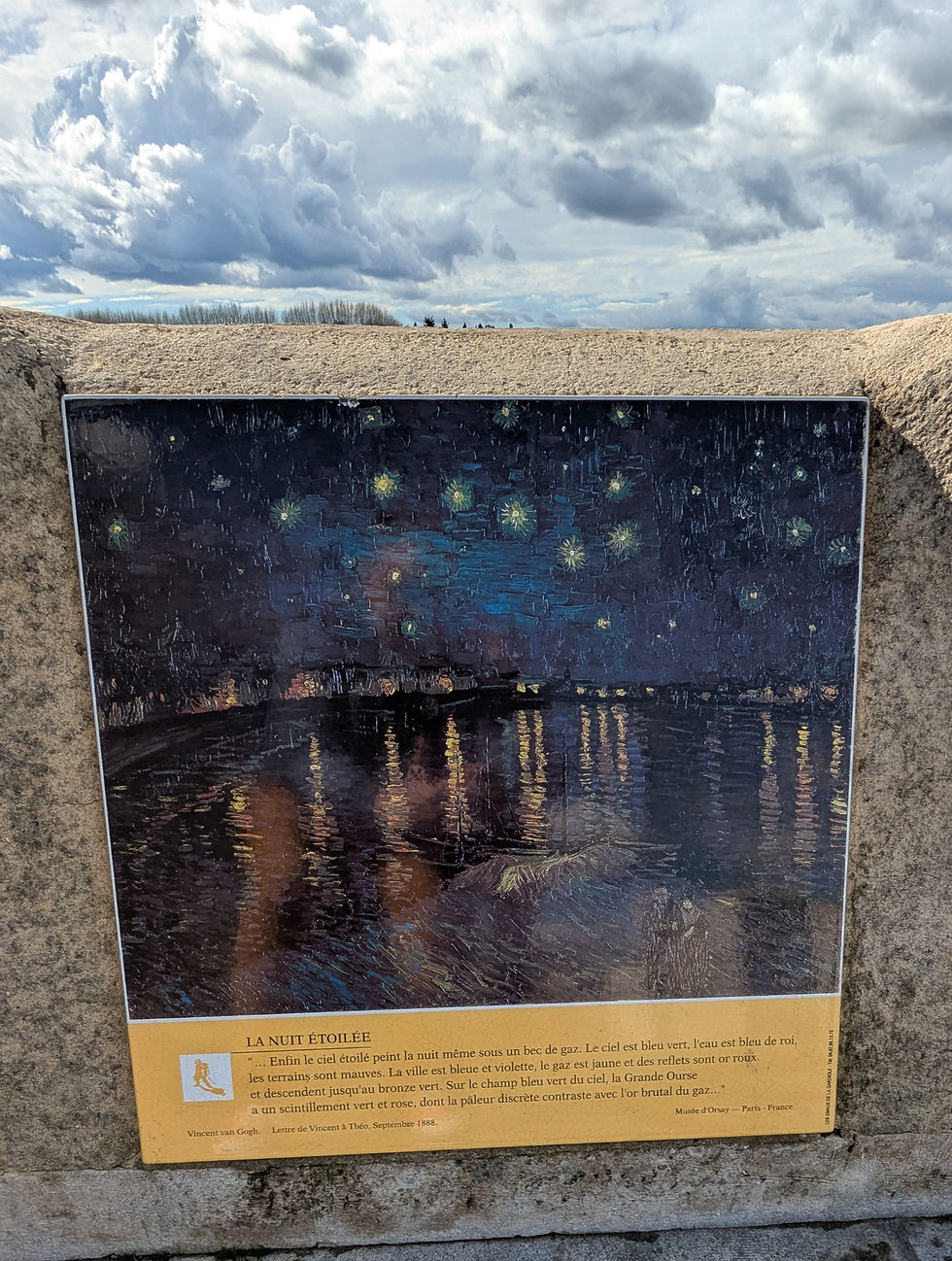
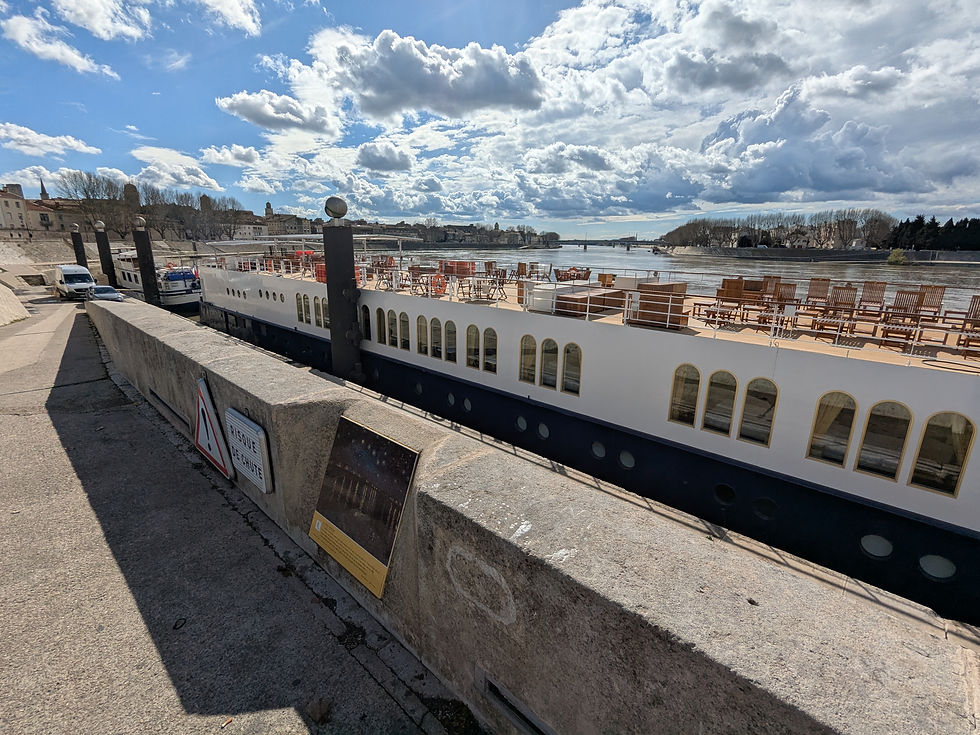
All throughout Arles, there are easels of Van Gogh’s work, placed at the site nearest to where he most likely painted (or got the inspiration for) the particular work. Similar to Aix-en-Provence with Cezanne and his medallions, we didn’t set out to do a “Van Gogh Walk,” but we made it to a number of his easels, and are happy that we did. After our visit to the imaginary yellow house, we walked due west and came to the banks of the rushing, muddy Rhone. Another one of Van Gogh’s easels can be found along this stretch at the bend in the river. Starry Night Over the Rhone, or simply Starry Night, is not to be confused with The Starry Night which was painted in nearby Saint-Remy de Provence and will be discussed in a later blog entry. You can really get a sense of the view and angle from which Van Gogh was looking over the river, toward Arles at the river’s bend. It’s so fun to find these easels and take a look at where a master did his thing from almost the exact spot.
As I stated earlier, the Roman emperor Constantine was drawn to Arles and even built thermal baths there. A short walk from the Rhone and Starry Night, one can find the remains of these baths. Included in the Arles Advantage Pass, it’s a nice, small site where you can behold the different chambers, pools, sluices, and spouts. I am certain, comely young maidens strumming harps and wearing togas (or not wearing togas, if you know what I mean) sat in a comely manner on the stone benches as hot spring water cascaded down from above. The (purely factual) image of maidens in my mind’s eye was worth the price of the Advantage Pass.

Another short stroll took us yet again to one of Van Gogh’s spots: Place du Forum. This is a small plaza, lined with cafes and sporting a fine statue of the literary Nobel Laureate Frederic Mistral. This plaza is the scene for Van Gogh’s Cafe Terrace at Night, and the small, yellow cafe has been lovingly restored to resemble the painting.
Just one block south of Place du Forum, we entered Hotel de Ville (town hall) and enjoyed some of the fine statuary within. We once again utilized the Advantage Pass and descended some stone stairs into what I assumed was a small tunnel going from one side of the street to the other. The Cryptoporticus was not at the top of my anticipation scale. I just figured it was a neat tunnel that would take us to another neat(er) site. I was wrong. A cryptoporticus is an underground structure with arched vaulted ceilings used to support a large structure on the surface, in this case the Forum in Arles. So, basically it’s a basement used for support and leveling on the surface. despite its name it is not a crypt.


The open space in the cryptoporticus was utilized for storage, but due to the proximity of the river and underground springs in Arles, it was much too damp to store grains, so I have read that it was used as a prison and to hold slaves. So there’s that. It forms a “U” shape and is 90 meters at the long ends and 60 meters in the middle, but it seems much larger with the columns, arches, and various side storage chambers. There is debris of many shapes laying about, dripping ceilings making the most deliriously wonderful stereotypical “plop plop plop, drip, drop, drip” noises that echo throughout. There are artificial lights placed throughout, but they actually keep it rather dim, and a few sky lights opening to the outside give a bit of glow as well.

I know that I use comparisons to video games often, but dear gods, devils, and demons, this simple “tunnel” was amazing! I kept expecting to run into skeletal warriors, mad mages, and a few angry ogres around each corner and behind each pillar. We walked slowly and really explored. There isn’t much in terms of art or fancy design remnants, but if you want to see a wonder of Roman engineering and architecture (while at the same time cosplaying as a brave, or cowardly, warrior) then please, oh please, descend into the Cryptoporticus!

We popped out of Cryptoporticus in the Place de la Republique where we gazed upon the splendor of the Obelisk of Arles, a spire dating back to the 4th century and constructed under the auspices of Constantine II. It was broken, rebuilt, and now stands over a grand fountain. This plaza is a must-see, not only for the fountain and the Eglise Sainte-Anne d’Arles (circa 1630), but also for the stunning Cathedral and Cloister of Saint-Trophime d’Arles.


Saint-Trophime was built between the 12th and 15th centuries and holds just a mind-boggling amount of art, sculpture, and architecture spanning the centuries since. There are more saint reliquaries than any other church I have visited before or since, including a skull that is supposedly from the 1st century that comes from one of the “innocents” massacred under King Herod of Judea when he ordered the death of all males aged two and under in order to root out the impending threat of the new messiah. True or not, it’s pretty wild to look upon a child’s skull under glass that may or may not be 2000 years old.
While the cloister is not huge, the sheer amount of marvelous carvings on pillars, walls, and gorgeous vaulted ceilings and arches demand a slow walking contemplation. We climbed up to the top, and the blue sky spotted with fluffy spring clouds made a perfect backdrop to the sacred medieval roof with tower and all. Much like the rest of Arles, the Cloister and Church of Saint-Trophime are must-sees and included in the Advantage Pass.


Our last stop in Arles was the fabulously preserved building and courtyard now known as Espace Van Gogh. This is a former hospital where Vincent, ever more falling into the throes of his mental illness, painted a scene of the yellow courtyard titled Garden of the Hospital in Arles, one of his more special masterpieces. There is an easel inside the courtyard, and they have preserved the space to look quite like it does in the famous picture. A nice gift shop inside sits like a thirsty spider to entrap you and your spending euros so you can procure all the Van Gogh bric-a-brac your heart may desire. I may or may not have fallen prey to this gift shop and the tchotchke inside, many of which I bought.

Having packed a two-day tour into one day, we finally decided to part ways with this fine Provencial town, loaded with Roman history, artistic splendor, cute, winding French streets and boulevards, and the mighty Rhone. We casually strolled through the town center to get back to our car, passed yet another carousel (I need to make a list of how many we have seen in France), and were on our way. But, we had one more stop just outside of town.

The Langlois Bridge is just to the south of Arles, over an irrigation canal connected to the Rhone. It’s another site with a Van Gogh easel, as Vincent enjoyed painting here in 1888. He made five paintings and a few drawings of the small, quaint drawbridge. In 1944, upon retreating from Arles after getting their asses handed to them during WWII, the Nazis destroyed the bridge via explosives. As I stated earlier, fascists ruin everything they touch, and here is yet another example. The bridge has been recreated and while it’s not the original, it is still a nice, bucolic spot, near a small highway with parking across the road. Be careful when crossing, as there’s a bend in the road to the south, and cars also come speeding out of town to the north. Despite the highway and rush-hour motorists whizzing by, I remember the spot as rather quiet, peaceful, and contemplative. It was pleasant. I am pleased that we stopped by on our way out of town, even if it was a tad out of the way, as it was a nice manner in which we could say “au revoir” to beautiful Arles.

That night, back in Avignon, we found we were quite famished, as our luncheon salad, and whatever bread I had procured that morning, was simply not enough to sate us. I saw a cozy little spot earlier in the day, when I was taking my morning constitutional before we left for Arles, called Mamma Corsica. I fell immediately in love with the facade, checked the menu and was pleased. It's just steps away from Place Pie, in the heart of Old Avignon. Place Pie is a bustling plaza lined with cafes and features the impressive and imposing Tour Saint-Jean which dates back to the 14th century when the popes called Avignon home. It was part of the city's walled defenses and now stands silently, and grandly, over the pleasant plaza.
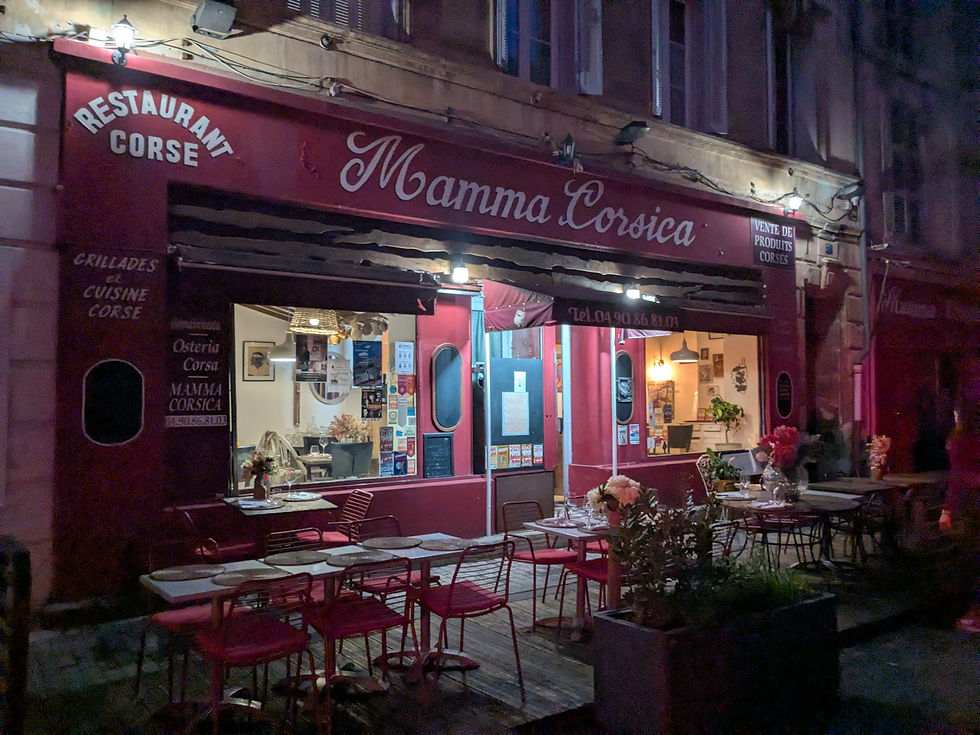
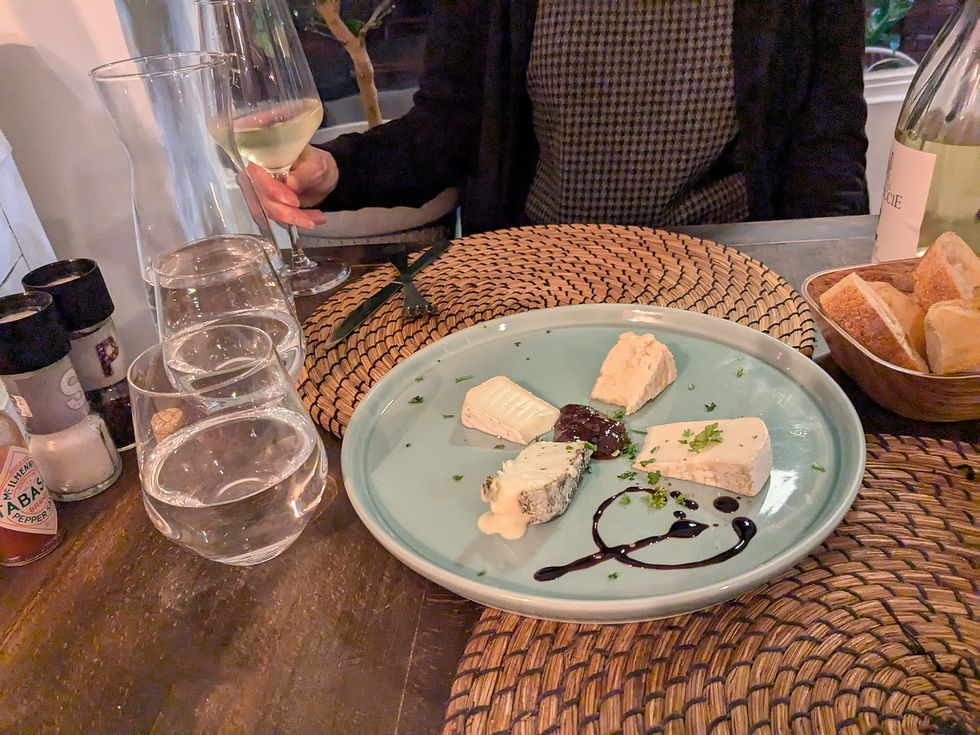

Mamma Corsica sits silently and yummily just out of the gaze of the tower, and it offers up some of the most comforting of all cozy comfort foods I've ever had. I can't prove this, but I believe the “Mama” of Corsica in this equation was doing the cooking, as everything we had plated was supreme in the “home cooked” way of feeling. The host/server was from Corsica and was very pleasant and patient with my silly questions and weird American mannerisms. We split the “Plate of Corsican Cheese” that arrived with the customary basket of bread and also a little wad-dollop of what I believe was fig jam.
I got the fish of the day, piled high with wonderfully prepared vegetables. Lani got the vegetarian plate that had some really nice, round fritters. This was comfort food beyond compare. All was delicious, and with the bottle white Corsican wine, we were sitting pretty. I recommend Mamma Corsica, not only for the food, the cozy Corsican-themed interior design, but also the kind and attentive service.
We walked home through a light rain on the slippery stone streets, passing the Tour Saint-Jean under a cloudy yet moonlit sky. It was marvelous. Arles, Mama Corsica, Place Pie et Tour Saint-Jean, je vous aime tous!


Comments